The post Halloween Costume Ideas for 2020 appeared first on Well-Trained Mind Academy.
]]>Doctor, Nurse, EMT, Dentist
We bet you’ve already got a disposable mask on hand, which is step one of dressing your child as a healthcare worker this year. Most of these costumes can be easily created by just adding a white coat, a stethoscope, and a nametag. If your kid happens to have some sweat clothes or pajamas that are a solid color and match, that will do just fine for “scrubs.” We especially like this DIY costume idea for this year because your child’s community helper costume can help to honor all the essential personnel and the incredible work that they have done throughout these past months of uncertainty.
Astronaut

The large clear “face shields” being used by some in place of face masks already look pretty close to astronaut helmets. You can embellish this look by dressing your child in a white sweatsuit and making them accessories like “space suspenders” using aluminum foil or silver duct tape. Additionally, red or blue painter’s tape could be used to represent the “seams” of the spacesuit, and white winter gloves can contribute additional realism to the costume. A NASA insignia is pretty easy to sketch by hand, cut out, and pin to your child’s shirt. However, if drawing isn’t your thing, you can print the logo out from this site. And if you need to fill an afternoon before Halloween, why not do some papier-mâché and have your future astronaut create a helmet to go along with their plastic shield (or even a jetpack!).
Fun Clown
Start with a folded disposable medical face mask, and then take it out of the package as is. Have your child draw and color some big, outlandish clown-style lips on it. Once they complete the lips, expand the face mask (so that the folds open). Then, have your child draw and color some goofy teeth and a tongue on the inside portions. Adding on clown accessories should be pretty simple (remember that clowns often wear oversized clothing, so you may be able to raid your own closet for that part of the costume). The neatest thing about this costume is that it serves as a bit of a party trick, too. When on your child’s face in the “folded” position, the mask will only display the lips. However, when the mask is “flattened,” you’ll be able to see the entire open mouth.
Vincent Van Gogh
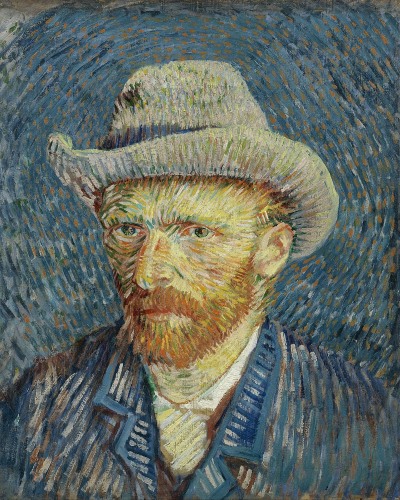
Do double-duty with your child’s Halloween costume and allow it to serve as a means of teaching art history, too! Have your child dress as Vincent Van Gogh by finding an old blue or black suit jacket and a gray hat (to recreate Self-Portrait with Grey Felt Hat) or straw hat (to recreate Self-Portrait with Straw Hat). Then use tailor’s chalk, school chalk, or even paint (if you don’t mind permanent embellishments) to add the signature stroke-marks to the jacket and hat. Use face makeup to apply similar brush strokes to the child’s face, and use paint or markers to decorate a disposable face mask to add on Van Gogh’s red beard and mustache. Lastly, finish off the look by supplying your child with a paint pallet and an oversize brush to carry as a prop.
John “Grizzly” Adams

If your child is a budding outdoorsperson, they could dress as Grizzly Adams and have a night on the wild side. Old-fashioned or heavily-used clothes, with fake “fur” attached at the lapels and collars, will go nicely with a felt hat. Using a disposable face mask as the base, create a shaggy beard and mustache with grey, white, and brown wool or yarn glued to the mask in the shape of a beard. Have your child carry a stuffed bear and walking stick with them to complete the look.
We Won’t Forget Halloween 2020
Allowing your children to dress up, while also thinking of ways to keep their costumes fun and safe, can be one way that we continue to provide normalcy to a year that has been anything but ordinary. These Halloween costume ideas would all be great for a socially-distanced neighborhood costume parade or school celebration. Additionally, these costumes should also translate well to online gatherings. We hope that our Halloween costume ideas have sparked some creative inspiration in you, and we’d love to see all the genius, socially-safe costumes you and your children come up with this year!
The post Halloween Costume Ideas for 2020 appeared first on Well-Trained Mind Academy.
]]>The post Sitting & Stress: How Online Students Can Manage Both appeared first on Well-Trained Mind Academy.
]]>Yet, stress is only bad when we fail to listen to what its presence is trying to tell us! Stress often happens because we don’t set a goal to deal with it in very specific ways. Our first reaction to stress might be, “I have too much on my plate.” But what stress might actually be telling us is, “I’m not prioritizing the right things in life because I am failing to make specific, concrete actions part of my daily routine.” Stress reduction takes practice!
Here are ten healthy habits for students who are taking most of their classes online to help deal with stress.
1) Limit your sitting periods to 50 minutes, give or take.
Set a timer that forces you to get up once an hour. Set a timer on your phone or computer every time you sit down. (Sure, an expensive, fancy fitness tracker or smart watch is nice but unnecessary.) When you hear the alarm, get up and move!
2) Move your shoulders and neck actively.
An important movement is to loosen up your shoulders, one of the most complex joints in your body. Here are a couple of videos to walk you through shoulder stretches and neck movement in real-time.
3) Leave the indoor room you are working in and find space outside.
Get out of the room you are sitting in and go outside. When you are outside, get into the sun to feel refreshed and take a couple minutes to breathe in and out, deeply and slowly. Stress and tension can often be quickly lowered by raising your oxygen intake levels. You might even find yourself clearing your mind a bit!
4) Increase your range of motion with lunges and squats.
If you’re feeling a bit more adventurous, get some blood into your legs. Take a few moments to squat or lunge forward/back with one leg. Both are basic movements. For some extra work, instead of bending over to pick anything on the floor, always squat or lunge to get it. Yes, you’ll look funny, but you might also keep from spontaneously pulling a muscle in your back.
5) Take up a household chore to break the monotony of school.
Movement is more than just exercise: basic home chores can be a great break. Get up, take a minute, and make your bed. Pull out the vacuum or broom and help clean up a bit. Take a few moments and wipe down the bathroom or fold that pile of clothes. You’ll get some movement and your home will feel a bit better to you and everyone you live with.
6) Sit on funky items, like a yoga ball.
Change up your sitting routine when you get back to your desk. If you have one, sit on a yoga or exercise ball. If you want to get one, you can find affordable ones on Amazon.
7) Stand up while reading, or when attending class.
Guess what! You don’t need to be sitting down all the time. The nice thing about online learning is that you can turn your speakers up or put in some wireless headphones and walk around the room as you participate in class. Even when you are doing your reading, pace around your room and read out loud. This practice could even help your focus. Double win!
8) Plan your breakfast and lunch each day.
Healthy, nutritious eating pays off all day long. Make sure to have quality options for breakfast foods that include plenty of protein, not a lot of sugar, and a balanced amount of carbohydrates. Try to have at least one vegetable and maybe some fruit at lunch. Drink lots of water with each meal. You might need to do some meal preparation on the weekends. It is totally worth it!
9) Set up a routine of healthy snacks, especially avoiding high sugars.
Keep whole food snacks on hand, especially ones that are low in sugars (ahem…avoid the candy!). Sugar gives you a quick boost of energy, but it wears off fast; your hunger comes back, and you can crash. Choose something like nuts, fruit, and cheese in any combination. Again, keep hydrated by drinking plenty of water during the day. As an extra bonus, you know you’ll have to get up and move more to go to use the bathroom!
10) Keep to a schedule of regular exercise and quiet time of reflection.
Finally, carve out time in your week for regular exercise (even if it’s a simple 20-minute walk) and quiet time for reflection (anything from reading a book you love, to meditation, prayer, or journaling). Try to exercise and have your period of reflection at the same time each day. Don’t skip because you have work to do. Make sure to take the time for yourself so that you can keep your mental balance.
Healthy Habits for Students: Small Changes, Big Results
If you make reducing the stress that comes from sedentary life a goal every day, you will feel so much better and as a result, you’ll have a more successful time with your studies. Set a small, attainable goal each day — one that you know you can keep. Big change always comes first from small steps. You can do it!

By Mattias Caro, Kinesiology Instructor
Teaching is not just my passion but my vocation. I want to pass on what was given to me, and more importantly, I want to plant, water, and nurture the seeds of life-long learning in my students. I believe in providing the virtues and tools necessary for every student to make learning a life-long endeavor.
The post Sitting & Stress: How Online Students Can Manage Both appeared first on Well-Trained Mind Academy.
]]>The post Why Pandemic “Learning Pods” Could Be the Wave of the Future appeared first on Well-Trained Mind Academy.
]]>What is a learning pod?
The term may be new, but in certain ways learning pods and micro-schools are as old-school as they come. “Learning pod,” or “pandemic pod,” is a broad term to describe small groups of students who learn together, typically in each other’s homes. Building on the one-room neighborhood schoolhouses of earlier years, learning pods usually include between 3-10 students. The learning pods aim to provide kids with the social stimulation and collaboration of a classroom environment. Some pods work on a rotation; parents share supervision of their children and of their classmates as they complete classwork remotely. Others opt to hire tutors and teachers to work with their children in person, forming a more formal “micro” or “nano” school, rather than supervising remote learning pods.
Though the pandemic has pushed many parents to consider the learning pod or micro-school model, it isn’t a new idea. Many homeschooling families have used micro-schooling and other “outsourced homeschooling” methods as an alternative to traditional education. These alternative school structures afford students a more flexible educational experience. More formal micro-schools sponsored by organizations like Weekdays and Microschool Revolution additionally employ pedagogical methods beyond standardized testing. These alternative instructional methods, including Socratic dialogue and kinesthetic learning, build multiple different skill sets (at many different skill levels). Crucially, the emergence of online learning and social media have both only improved homeschoolers’ educational opportunities over the past several years.
Are learning pods beneficial?
Both approaches have clear benefits for both parents and students. Pods and micro-schools provide individualized attention to students due to their small size, preventing children from falling behind in class. Forming a “pod” with other families can aid students’ learning, providing a safe hands-on classroom experience for kids amid COVID-19, and a relief from 24/7 childcare for parents working from home. Additionally, students can avoid the fatigue of online schooling with routinized contact with peers in the same or similar classes.
So how do you find — or start — a pod, or micro-school?
Ask around. If you’re involved in a parenting group or are friends with other parents in your neighborhood, consider asking them what their plans are for the upcoming school year. Ask if there are other local parents that they know who might be interested in forming a pod.
Look online. Look for Facebook groups in your area for learning pods or micro-schools. You might also look more generally into parenting groups in your region for tips on virtual schools, tutors, and teachers. Interested in starting your own micro-school? Consider reaching out to parenting groups to offer teaching and tutoring, either virtually or in small pods.
Reach out to an organization. Organizations like recent start-up Learning Pods, as well as Weekdays, Microschool Revolution, and others, can connect parents with like-minded families and with dedicated teachers and tutors. Some even offer aid with organization and teacher salaries, as well as comprehensive background and reference checks for incoming educators! Microschool Revolution additionally offers funding opportunities for parents and teachers interested in starting their own micro-school based on their skill set.
Creating community in uncertain times
Coordinating your child’s education is no easy task with the uncertainty of COVID-19. However, finding parents with similar educational goals can be mutually beneficial. These connections help you create innovative educational solutions and opportunities for your children and theirs. Finally, forming a pod with other like-minded individuals can provide your child — and you — with the chance to socialize safely with a group of people you trust.
The post Why Pandemic “Learning Pods” Could Be the Wave of the Future appeared first on Well-Trained Mind Academy.
]]>The post Kayla Meyers’s Favorite Writing Assignments appeared first on Well-Trained Mind Academy.
]]>My favorite writing assignments can generally be grouped by their purpose and benefit to students. No matter what level of writing I’m teaching, these types of assignments will bubble up in one form or another:
1) The Breakdown
At some point in the year, each of my writing classes attempt their first research paper for the course. To refresh and hone my students’ research and planning skills, I like to break these papers down into smaller assignments. I often ask first for a list of sources, then the notes, the outline, and sometimes a partial draft. By dividing a multi-step essay into smaller assignments, I’m able to track their progress and help course-correct as needed. Students also benefit from these more digestible steps; they see that they can easily tackle large papers.
2) The New Media Assignment
Whether it’s movies, comics, or fine art, there is always one assignment in each of my classes that introduces students to an analysis of different types of media. These assignments ask students to apply the same skills they use for thinking about literature in an analysis of visual culture. Of course, students are fond of these assignments. Who doesn’t love getting to watch a movie or read a comic for class? But these lessons also sharpen their critical thinking skills. They show students that they can apply the same analysis we do in class to the media and information they encounter in their everyday lives.
3) Understanding Themes
In the early stages of writing, students are taught to order the information for their essays by chronology. This is a first order system of organization. But, as we progress, students are pushed to learn how to synthesize details and information into groups based on themes and shared qualities. This challenges students because they must transition from a familiar system to a new system of essay organization that requires more abstract thinking. These assignments are my favorites because they push students in their development, closer to the kinds of essays they will develop in college.
4) Editing Practice
Learning how to apply edits and criticism to your writing is one of the most taxing exercises. No one enjoys confronting the mistakes they’ve made, let alone thinking critically about them. But this process is one of the best ways for students to practice better writing. Whether workshopping in class, asking students to complete “rewrites,” or offering extra credit for revised work, I bake this practice into my writing assignments. The editing process usually becomes a fun exercise as students grow more accustomed to it. I love the process from start to finish because it is exciting to see students grow and mature in their editing practice.
5) The Annotated Bibliography
I am obsessed with sources. I mean, I wrote a book on best research practices and how to credit sources. So, obviously, teaching how to find and evaluate sources for a paper is an essential part of my classes. Annotated bibliographies push students to practice articulating why they’ve chosen a source and showing its benefit to their paper so that they can directly apply these lessons. This assignment is deceptively simple, but requires deep analysis and sharpens students’ ability to critically assess sources.
Of course I love these writing assignments, and it turns out my students do, too! My Expository Writing III students consistently leave the class saying the movie review is their favorite assignment of the year. In all of my classes, I get emails asking for opportunities to workshop and revise their papers. This shows me that students love the process-orientated assignments.
You can incorporate these assignments into your own homeschool. Try applying a method of analysis learned in one subject to something else. For example, apply the scientific method to baking, or make a historical timeline based on weekend activities over the course of a month. If your student shows interest in a new hobby, have her create an annotated bibliography about the subject. The skills and benefits in these activities extend well beyond writing. I hope they’ll become your favorite at-home assignments, too!

By Kayla Meyers, Writing Instructor
I earned my B.A. and M.A. in American Studies from the College of William & Mary. In addition to teaching research and composition for the Well-Trained Mind Academy, I’ve coordinated many education focused conferences and events, including SXSW EDU. I write broadly on topics in topics in pop culture, politics, teaching pedagogy, and writing practice. I recently wrote Who Said What? with the Well-Trained Mind press, which guides writers through the tricky process of evaluating sources to produce accurate and clear writing.
The post Kayla Meyers’s Favorite Writing Assignments appeared first on Well-Trained Mind Academy.
]]>The post Lines Before Rhymes: Teaching Students How to Engage with Poetry appeared first on Well-Trained Mind Academy.
]]>Needless abbreviation in text messages, say. Or suspenders on pants that have belt loops. Even the lack of complexity in a barbecue chip’s flavor profile. These are all things that—to me—fundamentally defy explanation. But if there is one thing that does make sense, one unencumbered clarity, one certainty that fits neatly alongside such foregone conclusions as the sun’s rise and involuntary breath, it would be this: students don’t know what to do with poetry.
It’s not their fault. Poetry is the kind of thing that people know they’re supposed to say is significant and meaningful but would never choose to read unless they absolutely have to. Like when your friend asks if you like her haircut. Even as you struggle to imagine the series of life choices that could result in the distressing angularity of her once-acceptable head, you manage something along the lines of, “wow, you, wow, it’s really something!” Some vague nothing that suggests appreciation. That’s poetry. Your friend’s terrible haircut.
And even when a student is curious enough about poetry to seek it out on their own time, and is also somehow lucky enough to live near a bookstore that, you know, actually sells poetry, the would-be reader finds the shop’s shelves filled with the same stuff you had to read in school. Don’t get me wrong: I have nothing against classics. I’m obsessed with Dickinson. John Donne, as well. And Coleridge, Shelley, Keats, and Hopkins, too. The preceding sentence was even written in iambic pentameter! But if a young person walks up to a bookshelf and finds the same poets they didn’t really understand when they read them in their textbooks, how can we possibly expect them to find poetry relevant to their actual lives? Unless, that is, they know what it is they’re looking at.
And that’s the problem—they only sort of know what they’re looking at. Sure, we teach them to assign capital letters to rhyme schemes, we equip them with “synecdoche,” “onomatopoeia,” and other serpentine terms of figurative language play; we even do our best to make the identification of stressed and unstressed syllables into something other than, well, the identification of stressed and unstressed syllables. But all too often we stop just short of conveying something—anything—that makes poetry a singularly dynamic form. As a result, students avoid poetry at all costs. Not because they’re resistant to it, but because they lack confidence. They know there’s something there, but because it remains infuriatingly elusive they feel exposed and inferior.
What’s to be done, then? If the results of Googling “how to make a student love poetry” are to be believed, the primary task is to do anything and everything you can do to make a poem into something other than a poem. You can, for example, set up an in-class poetry café where students wear makeshift berets and snap their fingers in approval—while not talking about poems. Or you can refer to poems as spiritual keepsakes and encourage students to anonymously gift wispy utterances to their classmates—while not talking about poems. But, honestly: that’s all nonsense. Not only do these approaches undermine the rigor of the poetry you assign, it also disrespects the student’s ability to find excitement in the sheer nuts and bolts of artmaking. Think of it this way: would you ever teach Moby Dick by giving out fake harpoons while students limp around performing self-destructive monomania?
For me, if you want to empower student engagement with poetry, then give them insight into something only poetry can do. No gimmicks, no games; just a new way to make sense. I mean, you already know that students are comfortable and confident reading fiction, right? They make inferences, predict outcomes; they’re attuned to the nuances of unstated elements of character and conflict. So ask yourself: what’s the fundamental difference between fiction and poetry? The answer is so obvious that it seems absurd: fiction goes from one margin to the other margin and poetry does not. Which is to say: lines. A poem is made out of lines. Poems have lines and students have no idea why. And, really, I can’t say that I blame them.
From the earliest stages of language acquisition, children learn the supremacy of the sentence. Sentences build and destroy, they ask and demand; the sentence allows us to be heard. As such, when we read or write or speak, we prioritize the sentence. To do otherwise would be absurd. But, with poetry, the sentence is distorted. It’s broken and manipulated. It’s there, it’s complete, it’s still graspable, but the safety of margin-to-margin expression has been abandoned. Instead, what we’re left with are these slivers of incomplete thought unfolding of their own volition, following some unstated system of expression that we can never really access. And that’s the beauty of it.
To put it simply: the line is a puzzle piece. Each piece has an image of its own, a self-contained picture. It may be incomplete in the context of the picture we’re intending to put together, but we can’t construct the big picture without it. Each piece also has its own shape, its own bends and curves, its own expressive form. That individual form, though, relies upon the forms of the piece before it and the piece after it in order to fulfill its purpose. No matter what you do, there is no picture without the visual and structural integrity of each individual piece. The problem is: we think in pictures and wholes, not bits and slivers.
Take the following sentence, for example:
After all is said and done, I’m still dying to see you. Dying to hear your voice
again, just once before the end.
If I were to ask a student to take that sentence and break it into lines, this is what would happen:
After all is said and done
I’m still dying to see you.
Dying to hear your voice again
Just once before the end.
Okay, fine. But, um, those aren’t lines, I’m sorry to say. Those are clauses. That’s a little stack of syntax. And let me be clear: lines and syntax are not the same. In fact, I’ll go one step further. I’ll say here what I’ve been saying to creative writing students for the last twenty years: if you’re going to break all of your lines at the end of the clause, just write prose.
What would I do with that sentence instead? How about:
After all is said and done, I’m still
Dying to see you. Dying to hear
your voice again just once before
the end. […]
Those, friends, are lines. The meaning of the sentence is in no way altered, but new possibilities of meaning and music are created outside the confines of the sentence. Notice how “I’m still” creates a massive moment of paralysis at the end of the initial line, even though that’s not how “still” is being used in the sentence. In fact, it isn’t just a moment of stillness, it’s a stillness created only now that “all is said and done” and the speaker has the time and space to stop and breathe. But, again—that is not what the sentence says. That’s what the line makes by virtue of its ability to create meaning from its unpunctuated drift into the empty page.
Then, notice how the lovely parallel deaths of the second line, split by the unabashed certainty of the period, create an opportunity for the speaker to insist upon his desire. The line’s rhythmic structure, the sheer force with which the reader encounters “dying,” “see,” “dying,” and “hear,” allows sound to physicalize the desperation of the speaker’s need to see and hear. Then and only then, only after we understand the severity of the speaker’s desire, do we learn that it is “your voice” that he requires. But we don’t have time to rest with that heartbreaking reveal. Everything is suddenly rendered fragile by the suspense of “before,” how it hangs there, staring over the edge of the cliff. Finally: the crippling gravity of “the end.” We fall, not knowing what comes next.
Just by attending to each line, we’re now creating multiplicities of meaning and music. Yes, the sentences convey what they intend to convey, but the lines shape, inform, and enhance the reader’s experience of the sentences. But wait. There may be some who would say, “yeah, but, now you’ve got that weird two-word line, smart guy. What do you plan to do with that?” Well, that depends.
I don’t know what this theoretical poem set out to say, but we’re digging our heels into what it means to make a line, so let’s play. Maybe the speaker needs to reflect a little, to express the confusion of his experience. Maybe he’s incapable of making sense of everything that he’s going through. So, we could add something like: “No one ever told me regret would feel so much like want.” Let’s see how it fits:
the end. No one ever told me
regret would feel so much like want.
Based solely on the structure of the sentence we created—and its ability to latch on to the puzzle piece next to it—we get a line that reads “the end no one ever told me,” which foreshadows the confusion and betrayal of the next line. Now, the heartbreak expressed in the first three lines isn’t just confined to his desire to see and hear, but it is retroactively cast over his entire life. Surely someone, somewhere could have warned him.
And that’s the extraordinary thing about a poem. Everything matters and everything contributes. All because of something so simple. Because something as innocuous as a line can be a prism through which the subject passes, readers have access to the full spectrum of what would otherwise just be light in margin-to-margin sentences. Reading in this way is a difficult and time-consuming process, to be sure, but poetry gives readers a level of imaginative agency that’s incredibly difficult to find in any other discipline.
Which brings us back to the real reason we’re here: to give our students the opportunity to experience poetry anew. I don’t mean to suggest that introducing students to the intricacies of the poetic line is foolproof. It isn’t. But I am suggesting that the line should be the very first thing we teach our children about poetry. Not rhyme. Not meter. Not acrostics made from the letters of their names. Lines. If for no other reason, a discussion of lines like the one we’re having here teaches them, in no uncertain terms, one of the most beautiful truths of the human experience: reading is an act of creation. They have a say. They get to pick apart the puzzle. Their ideas aren’t just important, they aren’t just necessary—the poem needs their ideas in order to exist. Even if they hate the poems they have to read for school, even if they find it all stuffy and boring and irrelevant, they’ll still know. They’ll know what to do, what to look for, how to talk about it, and why. I can think of no greater proof of empowerment than that.
Sadly, you’re on your own when it comes to ill-advised haircuts.

By Thomas Hummel, Creative Writing for the Rhetoric Stage Instructor and Published Poet
I have a BA in English from James Madison University and an MFA in Creative Writing from Columbia University. In my life outside of the classroom (if there is such a thing), I am a father, poet, and performing artist. My writing has appeared widely in national and international journals, and my first book, Letters & Buildings, was published by Subito Press in the fall of 2014.
The post Lines Before Rhymes: Teaching Students How to Engage with Poetry appeared first on Well-Trained Mind Academy.
]]>The post How to Structure Your Student’s Day appeared first on Well-Trained Mind Academy.
]]>Why is having a schedule important?
Structuring your homeschool days allows you and your child to know what to expect at any given time during the day, and this helps tremendously when transitioning from relating as parent/child to teacher/student. Schedules also give you a greater sense of purpose during your day, and they help your child to develop personal habits that can serve them well throughout their life.
Schedules help students know when they have to focus, and when they can relax. They know the windows of time they have to work on certain projects, and they can look forward to the time when they are meant to play or rest. What’s more, schedules help parents, too. They give you a sense of direction and accountability, and working them out ahead of time helps a homeschooling parent to think through their curricular goals for each child and subject before they actually start teaching the lesson.
How to Schedule
We know that every child and every family is different. This means, of course, that everyone’s days are going to be different. For some families, scheduling the same subject every day at the same time provides consistency across days that lends stability to the week. Other families find that working on subjects for longer periods of time, but only two or three days a week, works best for them. Do a little experimenting to find what routine works best for your family, and then stick with it for a while. When children know what to expect each day, they experience comfort in the routine and can even begin to work independently after adjusting to the rhythm of a school day in your home.
Homeschool Scheduling Resources
To start the process of setting up your own plan for the coming year, check out the sections on scheduling in The Well-Trained Mind (4th edition). You’ll find daily schedules, weekly schedules, and suggested schedules for each subject. Once you start planning your days, we suggest that you always start with the hardest subject for your student to learn. Students, like most adult workers, are most focused at the start of their school day. It only makes sense, then, that this is the best time to tackle the work they find most difficult. This strategy also allows you another benefit: if you have a student who tends to argue about her schedule, you can compromise by saying once she gets through the hard subject, she can work on whatever subject she’d like after.
Fortunately, the homeschooling world is full of generous and kind people, now more than ever! There are many bloggers out there willing to share their scheduling tips. Homeschooling Facebook groups are a great resource; join one that feels right for you (this could be a local group, a religiously-affiliated group, or a curriculum-driven group, like Well-Trained Mind). You’ll also find an endless flow of advice on the Well-Trained Mind community boards.
Homeschool Scheduling Pro Tips
- When working with young children, instead of trying to get through a set amount of material each day, work for a set amount of time. This approach also works well for older kids who are trying a new curriculum. This method helps everyone to focus less on achieving a set list of standards and letting the lesson flow towards the student’s interest, which can help your student to develop excitement for the subject at hand.
- There are many visual organizers and planners available for free on the internet, like this one from worksheetworks.com.
- Because they school at home, homeschoolers are always “on.” It is important to set firm boundaries around the school day so students can decompress, relax, and re-energize. Just like adults need to put “work” away when they end their workday, so too do children need permission and encouragement to enjoy a well-rounded social and family life outside of their studies.
- Nothing is going to happen to your student, or to you, if you feel like taking a break one day and doing something else! If there is a day where you just don’t feel like school, and a field trip to the zoo seems like exactly the right thing to do, go with your gut! You know your family best, and you know just how they work best.
Schedules can change!
Remember! One of the greatest joys of homeschooling is the flexibility that it offers. Embrace that element of the homeschooling life. Schooling at home allows you and your family to find the time that works best for you to learn, play, and attend to chores as a unit. Not only will homeschooling give your child the education they need, but it will also be a time for your family bonds to grow!
The post How to Structure Your Student’s Day appeared first on Well-Trained Mind Academy.
]]>The post Learning Styles vs. Learning Preferences: What You Need to Know to Help Your Learner appeared first on Well-Trained Mind Academy.
]]>Ask three different people about how they learn best, and you’ll likely get three different answers. These understandings of how we learn are supported by the many assessments that determine what kind of learner we are: there is Walter Burke Barbe’s VAK (Visual, Auditory, Kinesthetic), the model developed by the National Association of Secondary School Principals (know as the NASSP model), and Neil Fleming’s VARK (Visual, Aural, Read/Write, and Kinesthetic), to name a few.
Debunking the Learning Style Myth
It might surprise you to learn that the idea of learning styles (the idea that we learn best with one approach as opposed to another) has been thoroughly debunked by researchers. Scholars such as Lynn Curry, Doug Rohrer, and Harold Pashler, have found that we learn equally well if we listen to a lecture, watch a video, or build a model. These researchers, among others, find that individuals retain the same amount of information, whether they’re using the modality they say helps them best learn or not. The students in the examples above may indeed prefer to learn in a particular way, but that doesn’t mean that they learn better through a particular modality.
If the research on learning styles has been debunked, why should we care?
Learning Preferences
Rather than talking about learning styles, it’s more helpful to think about learning modalities, or learning preferences. These learning preferences can make a big difference in how open an individual is to learning about a new topic. When an instructor is considering how to split up a 50 minute class meeting, or a student realizes they’ve reread the same paragraph over and over again and still doesn’t grasp the meaning, consideration of different learning modalities could provide important new perspectives that might help the new information “click.”
We do know that learning happens when students encounter the same information through a variety of modalities, rather than only being approached through one method (only listening, only reading, or only doing, for example). And if learners prefer one modality over another, and they always give preference to that modality, then they may be missing out on opportunities to see information in a new way.
Here’s a brief introduction to the modalities mentioned, how they might be incorporated into your teaching as a homeschool parent, or how they might be included in your student’s coursework.
A Visual Approach
Any visual (a graph, chart, map, or diagram) conveys information differently than a written paragraph might. A student reading that the number of diagnosed cases of a viral infection doubles every five days may comprehend that information easily, but seeing the graph rise exponentially might drive that fact home. Similarly, reading about a battle may be helpful for describing what life is like on the battlefield, but it may be difficult to picture just where that frontline was drawn, or how the line moved over time. A map can convey this information quickly and succinctly and takes away the guesswork of the reader who might struggle to remember where a line two miles south of a town and running to the east might be.
Listening and Speaking
The now-debunked VARK defines those learners who learn best through hearing and speaking as auditory learners. While it’s unlikely that someone learns best by listening to a lecture on its own, the ability to listen to a lecture and also repeat information (speaking is part of the auditory learning preference) is key for communicating, whether in a classroom or work environment. Students who practice taking information, choosing what to present, and how to present it, make use of the auditory mode. Similarly, students who listen to a lecture, think about what they’re hearing, and take notes on the most important information will remember information far better—in more detail and for longer—than their colleagues who simply listen.
Learn by Doing
Folks who prefer kinesthetic learning tend to be doers; they might watch a video on YouTube that shows how to replace a washer on a sink and then do it themselves. After they’ve done this a few times, they can do the task practically in their sleep! In this example, as with practically every other example, you’ll note that there are few learning examples that only draw on one modality. Most kinesthetic learners are reading instructions, listening to someone talk them through the steps, or watching a video first to understand what they’re doing. None of those means of providing information are kinesthetic; it’s the execution, or checking to see that a thing can be completed, repaired, or made that provides the proof that something has been learned.
As a result, with certain topics and learning goals, a kinesthetic approach is a great way to test knowledge that’s not just theoretical, such as a driving test where a 16-year-old gets behind the wheel, in addition to taking a written test they take at the DMV.
Learning Preference, Not Learning Style
So what’s the takeaway? The research is pretty clear that learning styles as they are popularly known don’t exist. However, that doesn’t mean that students don’t have ways they prefer to learn, or that any learner will be open to acquiring new information through any delivery method. What’s key is that instructors don’t rely on one single style during a class session. This allows students to approach course material using a number of modalities and that they have more opportunities for the information to “click.” The variety of presentations also allows students to learn information more effectively and deeply.
Further Reading:
Bruff, Derek. “Learning Styles: Fact and Fiction — A Conference Report.” Vanderbilt Center for Teaching. January 28, 2011. https://cft.vanderbilt.edu/2011/01/learning-styles-fact-and-fiction-a-conference-report/
Pashler, Harold, Mark McDaniel, Doug Rohrer, and Robert Bjork. “Learning Styles: Concepts and Evidence” in Psychological Science in the Public Interest. Volume 9 Number 3. December, 2008. Pages 105 – 119. https://www.psychologicalscience.org/journals/pspi/PSPI_9_3.pdf
Nancekivell, Shaylene E., Priti Shah, and Susan A. Gelman. “Maybe They’re Born With It, or Maybe It’s Experience: Toward a Deeper Understanding of the Learning Style Mth. Journal of Educational Psychology. May 30, 2019. Volume 112, Number 2, pages 221-235. https://www.apa.org/pubs/journals/releases/edu-edu0000366.pdf
The post Learning Styles vs. Learning Preferences: What You Need to Know to Help Your Learner appeared first on Well-Trained Mind Academy.
]]>The post Why Your Student Should Take Advanced World Language Courses appeared first on Well-Trained Mind Academy.
]]>Taking an advanced language class is a gift to your child that allows them time to build the type of self-confidence that comes from being able to express thoughts and feelings in another language. Advanced language classes also promote the development of important skills such as cultural sensitivity and empathy, both of which are needed to be successful members of our modern world.
It’s no wonder why competitive colleges prefer students who take more than two years of a high school world language. In fact, the more selective a school, the more language they want to see. Colleges know that several years of study in one specific language can serve as a gauge of one’s grit and determination.
But not all programs are equal, of course. Below are just some of the reasons that our advanced language classes at the Well-Trained Mind Academy beat out the competition.
1. Live Interaction
Research shows that online language learning through programs such as Rosetta Stone fails to motivate students to continue or get them beyond a novice level. WTMA’s synchronous language classes simulate the traditional classroom dynamic by providing face-to-face interaction in an engaging virtual environment that draws students in and gets them excited to come to each class. Students see, hear, and interact with their teachers in real-time.
2. Use of Communicative Approach
Long gone are the days of boring translation and rote memorization. We use a communicative approach, which prioritizes students’ ability to communicate in the target language. This means that grammar and vocabulary rules are not taught in isolation, but rather are integrated so as to help students actually use them in conversation.
3. Small Group Work
One of the benefits of traditional in-person language classes lies in small group work, which allows for more time to practice speaking per student. At WTMA, we regularly separate students into breakout groups, or individual rooms that group together students to work on an activity or group project. Just like in an actual classroom, teachers can monitor the work of each group, which has access to a whiteboard and can collaborate via chat or the microphone.
4. Exposure to Target Language Books
All of WTMA’s language classes get to read a fun and engaging book in the target language, starting in the very first year. I’ve seen in my own classes the excitement of my beginner French students when they go from learning “bonjour” to reading a 100 page book all in French. While each week contains different fun activities, our reading weeks tend to be a highlight of the year.
5. Focus on the Target Language for Instruction
Studies again show that immersion is the best way to truly learn a language. We can’t fly you to Berlin or Tokyo for the semester, but we can make our classroom as immersive as it gets by keeping instruction in the target language as much as possible. In addition, we use textbooks that are in the target language to keep students thinking in that language while they work. Initially, students need a little extra instructor support to understand activities and tasks as outlined in the books. But their hard work pays off when they notice how much their proficiency has increased at the end of the year.
Transferring into WTMA’s World Language Program
Even if you didn’t start with WTMA, moving to us for higher-level language courses is a great choice! If your student has completed previous years of high school language with success, then they should be able to move into the next appropriate level at the Academy. We have placement tests available for each language at each level. While placements are not perfect, especially because they tend to be grammar-driven, they can give a good sense of where a student might fit. Instructors are prepared for students transferring into our world language program and can offer access to resources from previous years as needed.
To sum it up, taking a world language class beyond the first year is an investment that pays off more and more over time. With WTMA, you can be sure that your child gets the most out of their learning experience. Students don’t simply learn verbs and phrases. They gain access to an immersion-type experience with a teacher and group of students who learn alongside them so that they can converse in the target language. And, if any of these reasons still aren’t enough, consider that a world language isn’t just about learning about others—it’s also a process of self-discovery through which we come to better understand who we are and what defines us, all part of cultivating your own well-trained mind.
The post Why Your Student Should Take Advanced World Language Courses appeared first on Well-Trained Mind Academy.
]]>The post To Stare and Say Yes: A Teacher, a Ten-Year-Old, and Summer Reading in a Pandemic appeared first on Well-Trained Mind Academy.
]]>* * *
Like most other school systems across the country, Mathilda’s district is now digitally pandemic-proof. Zoom sessions at this time, writing lab at that time—everything she’s ever known about her learning environment is funneled through a laptop. While the transition hasn’t exactly been seamless, the truth of the matter is: neither of us can complain. We’re incredibly fortunate. Not only am I well acquainted with the challenges of digital pedagogy, but she’s also spent half of her life watching me conduct virtual lessons to virtual kids.
But for families that have been blindsided by the virus — for the parents unexpectedly thrown into teaching positions, for the students suddenly without camps and vacations and school plays and band concerts — I can’t imagine how difficult it’s been to adapt to life in quarantine.
So I asked myself: could Mathilda and I help?
* * *
“You know what I mean, Dad. It’s just, there’s no reason to call it analysis. We read and identify facts! Like, we summarize the main idea, right, and then just state facts. That’s not analysis! That’s comprehension!”
At this point, I really, really wanted to give her a high-five and take her out for ice cream or something. If, you know, going out for ice cream was still a thing we could do. Instead, I asked if she thought it was possible to fulfill the assignment while also honoring her definition of “analysis.”
“I know, Dad, I know. If I feel strongly about it, I should do what I think is best, right?”
And then it hit me. Here we were: Mathilda, frustrated and stifled by narrow expectations, and me, ready, as ever, to give potentially unhealthy amounts of attention to excruciatingly minor details. It was perfect. She’d never see it coming.
In short: I asked if she’d be willing to serve as a kind of case study, to answer random and largely impromptu questions to illuminate the student’s-eye view of pandemic life instead of ruminating on the vagaries of not-analysis.
As if she’d been expecting the question all along, she replied, “Let me just plug in my iPad first.”
* * *
Dad: What’s the first thing parents need to know about kids right now? Not in relation to school, just in general.
Mathilda: Expect sudden mood swings and try to be okay with it. One day, everything will be fine, no big deal, I’ll just text my friends, whatever, and the next day will be, like, this is the worst and I have no idea how much more I can take. I know it’s like a stereotype that kids are moody anyway, and that parents kind of expect that, but there’s a difference between expecting it because kids are weird and expecting it because the world is making us this way. So, yeah.
* * *
Dad: About the whole literary analysis thing. Your explanation of what was frustrating about that was perfectly reasonable and clear and articulate. But I think we should both acknowledge that there was a little more going on there than conflicting definitions of literary analysis.
Mathilda: Probably…
Dad: So, here’s the thing: there are tons of parents out there whose workloads have exploded because of the pandemic. And with the summer coming up, there’s going to be a lot of time to fill and a lot of low-grade, family-wide frustration about how to use that time. And parents always want their kids to read, so they’re going to be looking for ways to be supportive without being overbearing. That makes sense, right?
Mathilda: Yep.
Dad: Okay, so, thinking back to your frustration about analysis, what should parents be mindful of when it comes to, you know, monitoring reading habits or whatever?
Mathilda: There’s this, hmm. Sometimes, like, at school, adults will ask a student a question like, “Do you understand what the text is saying?” but the student can’t just say, “Yes.” If they do, then there’s this assumption that the student is either being defensive or lying. They can’t just say “yes” because the adult is, like, “Well, are you sure?” which only then makes it so the student is defensive.
Dad: A lack of trust, then?
Mathilda: Yeah!
Dad: Then what’s the solution? I mean, on the one hand, students could just answer in complete sentences, right? I mean, I know that’s the teacherly thing to say, but it’s true. On the other hand, though, it sort of seems like you’re suggesting that the problem is in the question…?
Mathilda: Well, yeah. “Do you understand” makes it so, I don’t know. It’s like I have to put on a show. Like I have to prove it. If you want to have a conversation about it, then ask questions about it, don’t ask questions about me. Or ask me to compare it to something else, or whatever.
Dad: Find a way to make the reading a gateway to new things? Make it the beginning of something rather than an end?
Mathilda: Yeah. I like that.
Dad: I know. Me too.
* * *
Dad: What else? Remember, this is your chance to give advice to parents! What do they need to know?!
Mathilda: Um, uh, I don’t know! Wait. How about this: don’t think that just because your kid is reading tons of graphic novels that they’re not reading.
Dad: Oh, boy. A conversation as old as comics!
Mathilda: But, seriously, though. I know you, like, teach a class on graphic novels and stuff, but that’s not why I’m saying this.
Dad: I know.
Mathilda: Sometimes I don’t think that parents understand that learning to read art, artwork, is like learning a new language. Pictures can tell stories that words can’t. Wait, no. It’s not that pictures can tell stories that words can’t, but that pictures tell stories in their own way. And knowing how to read them makes you a better reader, no matter what you’re reading.
Dad: I guess I’d make the same argument about film, television, animation.
Mathilda: Exactly!
Dad: Whether you realize it or not, you’ve opened up the literary analysis door again. I can’t tell you how many times I’ve said that asking probing questions about the structure of TV shows and films—about character motivations, about causal relationships, about why the flashback comes when it does, about what it is about the character’s past that made them behave a certain way, or whatever other questions you can drum up—is the easiest way to teach literary analysis. Anyway. You know you don’t get, like, bonus points for bringing up graphic novels, right?
Mathilda: Hmph.
* * *
Dad: Here’s something. You and I have read a ridiculous number of books together, right? How come it never seems forced?
Mathilda: What do you mean?
Dad: Well, I’m trying to imagine a scenario in which Grandma and Grandpa ask me, as a ten-year-old, to do some kind of family book club. There’s no way I wouldn’t have rolled my eyes. I know that sounds obnoxious, but it’s true. But you’ve never resisted it. I guess my question is in two parts: 1) what can parents do to make it so their kids don’t roll their eyes (granted, their kids are probably more conscientious than I was); and, 2) what’s to be gained by reading the same books?
Mathilda: Wait. Eye rolling first?
Dad: Yep.
Mathilda: Just don’t ask them. Pick a book you know they like and read it. They’ll definitely notice. Don’t turn it into schoolwork, though. Let it be, you know, something that happened.
Dad: How come?
Mathilda: It’s hard to describe. Because it’s…it’s like…it’s like there’s this shared experience that isn’t confined to any one place. It’s not like a memory. It’s like there’s this thing that only the two of you have. And it doesn’t matter what either of you does, or what stuff you have to do for school, or what makes you frustrated, or where you have to be, it’s always there. Always.
* * *
Dad: Just in case any of my students end up reading this, here’s an unrelated question: What’s it like to be Mr. Hummel’s kid?
Mathilda: It’s impossible to be bored. No matter what you do, it’s never just one thing. It’s like three things that don’t seem related but then suddenly are related and then he’s like, “What’s the square root of 42?” and I’m like, “How should I know?” and then I’ve somehow found the square root of 42.
* * *
Dad: Alright, this is the end. Any final suggestions?
Mathilda: I guess I would say, fill your house with books on as many different subjects as possible. I know that everybody says you should read anything and everything you can, but it’s actually true. Sometimes I just stare at our bookshelves and think to myself, “Yes.” All these different subjects and I can read any of them. It’s empowering. That knowledge never goes away. And it’s mine.
Dad: So, at the end of the day, we want our kids to be able to stare at the shelves and know that all they have to do is say, “Yes.”
Mathilda: Exactly.
The post To Stare and Say Yes: A Teacher, a Ten-Year-Old, and Summer Reading in a Pandemic appeared first on Well-Trained Mind Academy.
]]>The post When Homeschooling, Flexibility is Essential —Especially Now! appeared first on Well-Trained Mind Academy.
]]>Flexibility in Homeschooling
While we might not have been able to anticipate what has happened over these past few months, we can think through what has worked in our response to it. We can consider how adjusted expectations can help to give us all a little more breathing room, and we can embrace a worldwide community that, like us, has had their lives put on hold.
As an academy, we met the news of global shutdowns with many of the same concerns as everyone else. We also were quick to reach out to our academy families. We let them know that, in these unforeseen times, our aim was to work together to ensure a successful end to the school year for us all. This meant that our instructors offered flexibility with previously set deadlines. Additionally, our administrators worked with families experiencing a range of previously unexpected hardships.
At the Well-Trained Mind Academy, we’ve benefited from being an online institution. Our already-solidified expertise and comfortability with online schooling allowed us stability through our class schedules. However, concern for our students’ capacities to complete work and meet deadlines during the pandemic was critical during this spring semester, and continues to be so. Kayla Meyers, one of our writing instructors, shares how a classroom policy of flexibility was helpful this past spring:
A Liberal Extension Policy
In the tumult, my students (and my sanity) benefited from having a liberal extension policy in place that offered students flexibility and control.
Now that our school year is coming to an end, I’ve had time to reflect on just how important flexibility is when schooling a child. In the case of deadlines and extensions, I think about the importance of accountability.
In our day-to-day lives, accountability manifests through one’s ability not only to get a job done, but also to convey their progress or status. Communication skills thus prove essential. When giving an extension, I asked students to clearly articulate why they need an extension, and to create a step-by-step plan to get the work done. Practicing such communication, students in turn take some control over their schedules and learn to communicate effectively with authority figures. Both of these skills will serve them as they mature and grow increasingly independent.
Extensions are never open-ended, and students are held accountable to the deadlines they set. Developing time management skills to meet deadlines is thus imperative to the class. Additionally, students cannot request the extensions at the last minute. This requires them to do the basic planning to check their status and email me in advance. So even as it provides some flexibility, students must engage thoughtfully with their work and the deadlines each week.
While the benefits of my extension policy are clear to me in “normal” times, they have directly contributed to the successful completion of my classes despite the monumental disruptions of COVID-19. And I’ve wondered, how can this policy translate to the larger theme of flexibility in schooling at home? I’m sure many of you will be schooling through the summer, either making up for work that was not complete during the most chaotic period of stay-at-home orders, or replacing summer camps and clubs with enrichment activities and online classes.
Adapting to “Crisis Schooling”
As an academy, we have been asking many of these same questions. How can we encourage families to continue to pursue educational growth for their children, while also acknowledging that many of our families are not just “homeschooling” anymore? Our families are now “crisis schooling” as well. Parents who usually work outside of the home have relocated offices into their spare closets. Many other parents previously employed outside of the home have not had that luxury. They have been out of work for weeks and even months. And then we have parents who have been working throughout this crisis in their usual manner. They must balance parenting, schooling, and worrying about the potential ramifications of being an essential worker during this pandemic.
Fluid Summer Plans
These are just a few of the ways that life has changed for Academy parents. We aren’t even discussing yet how those changes (and many others) have affected Academy students. What do we recommend, then, as parents enter summer? Kayla Meyers shares her ideas about how flexibility could be the best approach to this year’s summer plans, too.
Personalizing summer projects to your student’s passions and schedule will ensure their continued engagement. By normalizing extensions in my class, students felt comfortable requesting them and persevering with their work rather than giving up. My students told me that this policy gave them a sense of independence and peace of mind. When you select enrichment opportunities attuned to your student’s interests and give them the opportunity to determine the pace of their work, students in turn “buy in” to their projects’ progress and completion.
Like all skills, there is a learning curve, and accountability through self-determination won’t immediately translate into success. But my extension policy has helped me instill communication skills and responsibility in my students that I know will benefit them no matter what life hurls their way. Giving them some wiggle room in such a challenging time may save their sanity, and yours, as we navigate the summer.
Summer 2020 Forecast: Sunny with a Chance of Change
We know that summer 2020 might not look the same as summer 2019. There may be fewer playdates, summer vacations, and days spent at the pool. It might be tempting, then, to decide to make the “best use” of this time by tasking your children with making up any and all of the work that might have been “missed” over the spring.
We urge you to work with your kids to decide what their summer, and yours, might look like. Surely there are educational goals that you all can strive towards. But we also encourage moving forward with an openness to flexibility as we continue navigating this international pandemic. Set goals as a family, and then assess them every few weeks to see how everyone is feeling about them.
Don’t forget that your kids, just like you, have been living through unfamiliar times. They need stability and comfort in their worlds, just like you do. And so, as we move into summer, we urge you to consider how you can best provide that to your family, while perhaps saving time for a few lazy days in the backyard or family boardgame tournaments as well.
The post When Homeschooling, Flexibility is Essential —Especially Now! appeared first on Well-Trained Mind Academy.
]]>